Darwin’s Theory of Evolution Through the Animals of the Galapagos
Darwin’s Journey to the Enchanted Isles
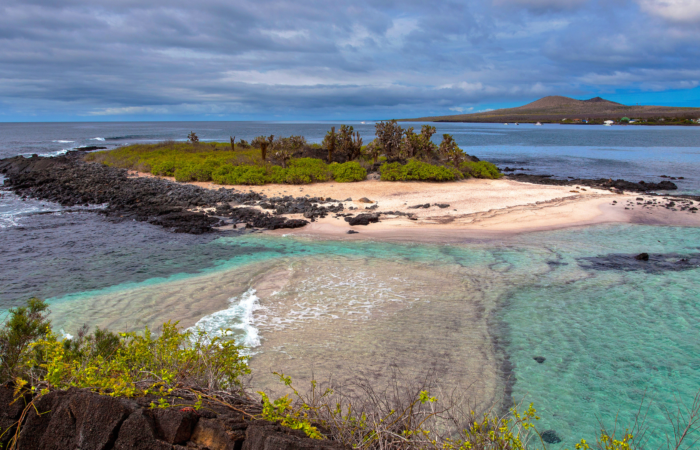
In September 1835, HMS Beagle dropped anchor in the Galápagos Islands, a remote volcanic archipelago nearly 1,000 km off the coast of Ecuador. On board was a young naturalist, Charles Darwin, whose keen eye and relentless curiosity would change science forever.
The islands seemed like a world apart — iguanas that swam in the sea, giant tortoises with shells shaped by their home island, and songbirds with beaks fine-tuned to their diet. Darwin didn’t yet know it, but his observations here would become the foundation of his Theory of Evolution by Natural Selection.
This guide explores the principles of Darwin’s theory through the lens of the unique animals of the Galápagos — creatures whose existence tells the story of adaptation, survival, and the intricate balance between life and environment.
Natural Selection — The Core of Darwin’s Theory
Darwin’s theory rests on a simple but powerful idea:
Variation exists within species.
Some traits give an advantage in survival and reproduction.
Over generations, advantageous traits become more common — species adapt to their environment.
The Galápagos provided a living laboratory where isolation, diverse habitats, and limited resources shaped species in remarkable ways. Each island was like a separate experiment in evolution, and its inhabitants bore the results.
Darwin’s Finches — Beaks as Evolutionary Blueprints
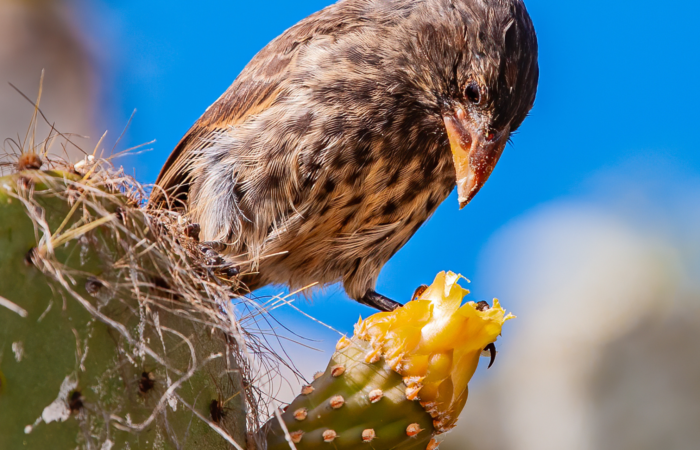
There are 15 species of Darwin’s finches in the Galápagos, each evolved from a common ancestor. The most striking difference? Their beaks.
Large Ground Finch (Geospiza magnirostris): Thick, powerful beak for cracking tough seeds.
Small Tree Finch (Camarhynchus parvulus): Slim beak for catching insects.
Woodpecker Finch (Camarhynchus pallidus): Uses cactus spines as tools to extract grubs — one of the few known tool-using birds.
Why it matters: These beak variations are direct evidence of natural selection. On islands with drought, birds with beaks suited to the available food source survived and reproduced. Within a few generations, the population’s average beak size could shift measurably — an evolutionary process observed in real time by modern scientists.
Marine Iguanas — The Sea Dragons of the Galápagos
Unique among lizards, the marine iguana (Amblyrhynchus cristatus) is the only sea-going lizard in the world.
Adaptations:
Flattened tails for swimming.
Strong claws for gripping slippery rocks.
Special nasal glands to expel excess salt after feeding on algae.
Behavior: They bask in the sun to warm up after cold dives, conserving energy in an environment where heat loss is constant.
Evolutionary significance: Marine iguanas evolved from land-dwelling ancestors. Over time, those that could exploit the rich algae beds survived better, passing on traits for swimming and salt excretion.
The Blue-Footed, Red-Footed, and Nazca Boobies — Lessons in Sexual Selection
The Galápagos host three species of boobies:
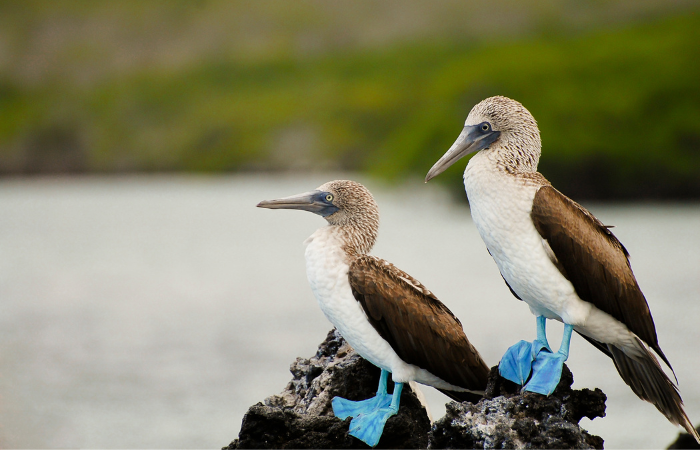
Blue-Footed Booby (Sula nebouxii): Famous for courtship dances where males lift their vivid blue feet — a signal of health and genetic fitness.
Red-Footed Booby (Sula sula): More arboreal, nesting in mangroves; smallest of the three but skilled long-distance flyers.
Nazca Booby (Sula granti): Larger, white-bodied with black wing tips, often nesting on cliffs and rocky shores.
Evolutionary significance: These species illustrate sexual selection — traits evolve not just for survival, but for attracting mates. Bright foot coloration in blue-footed boobies is linked to a healthy diet and strong immune system.
Giant Tortoises — Evolution Written in Shells
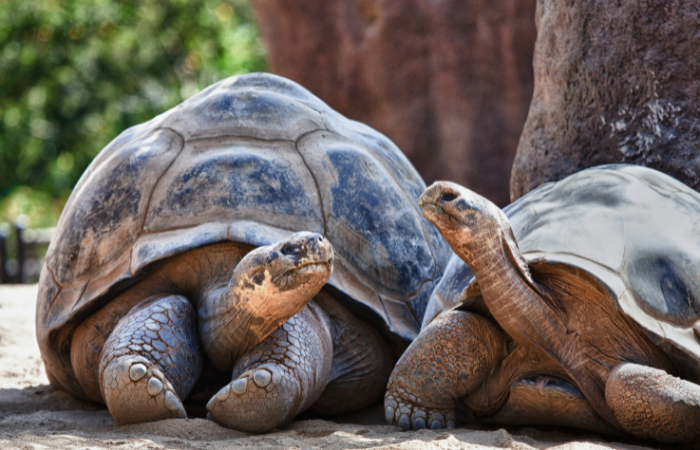
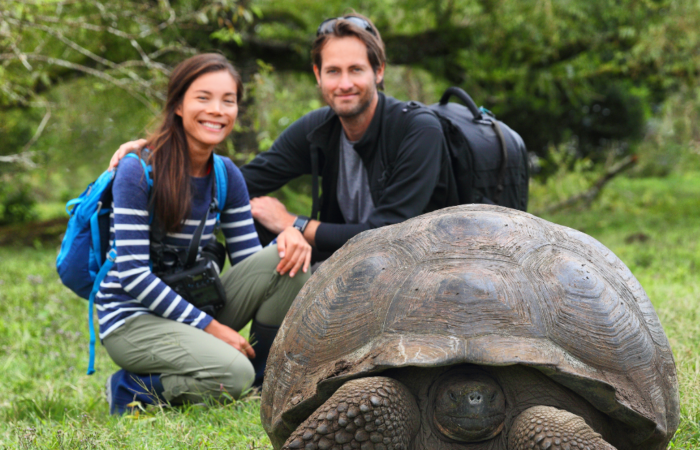
The Galápagos giant tortoise (Chelonoidis niger complex) is an icon of the islands, with several subspecies adapted to different environments:
Saddleback shells: Found on drier islands like Española, where the elongated shell front lets them stretch their necks to reach cactus pads.
Dome-shaped shells: Common on humid islands like Santa Cruz, where low vegetation dominates.
Why it matters: The shape and size variations are classic examples of adaptation to available food sources and terrain. Each island’s tortoises became genetically distinct over thousands of years of isolation.
Flightless Cormorant — The Trade-Offs of Island Life
The flightless cormorant (Phalacrocorax harrisi) has tiny wings and cannot fly — unique among cormorants.
Adaptations: Strong legs and large feet for diving; dense, water-resistant feathers for insulation.
Evolutionary story: On islands without predators, the energy cost of maintaining flight was unnecessary. Instead, selection favored stronger diving abilities to hunt fish.
Lessons for the Modern Terraveler
The Galápagos remain one of the few places where you can walk alongside living examples of Darwin’s ideas. Here, isolation, varied environments, and resource challenges still drive evolution today.
As a terraveler, witnessing a marine iguana’s salt sneeze, a tortoise’s slow march, or a blue-footed booby’s dance is more than a wildlife sighting — it’s seeing evolution in action. Respecting these species and their fragile ecosystems ensures that they continue to inspire future generations, just as they inspired Darwin.